
Note: Who2 is no longer being updated.
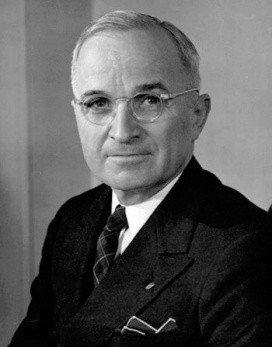
Facts about Harry Truman
Note: Who2 is no longer being updated.
Harry S. Truman Biography
Harry Truman became president of the United States unexpectedly after the death of Franklin D. Roosevelt on April 12, 1945. President Truman led the U.S. through the end of World War II and made the decision to use the atomic bomb on Japan.
Franklin Roosevelt was already the longest-serving president in U.S. history when he chose Harry Truman, then a senator from Missouri, to be his vice presidential candidate in 1944. Roosevelt died suddenly the next year, and Truman became the 33rd president and commander in chief of U.S. forces, just as war was winding down in both Europe and the South Pacific. Truman made the decision to drop two atomic bombs on Japan in August of 1945, finally ending the war.
Harry Truman steered the U.S. through the post-war period with the no-nonsense Midwestern style and colorful harangues of Congress that are now his hallmark. He placed on his desk a plaque reading “The buck stops here,” a reference to the notion of avoiding responsibility by “passing the buck.” As he gave a 1948 campaign speech, a supporter shouted out “Give ’em Hell, Harry!”, and that became an enduring slogan for Truman’s feisty style.
Truman was re-elected in 1948, in a contest many expected him to lose to the Republican candidate, Governor Thomas Dewey of New York. (A famous photograph shows Truman holding up a premature edition of the Chicago Tribune with the headline “Dewey Defeats Truman.”)
Truman tangled diplomatically with the Soviet Union in Berlin and elsewhere, founding the North Atlantic Treaty Organization (NATO) and setting the tone for the nearly five decades of the Cold War that followed. He gave up politics at the end of his second term, due in part to public discontent with the U.S. involvement in the Korean War. He was succeeded as president by Dwight D. Eisenhower.
Extra credit
Harry Truman’s vice president was Kentuckian Alben W. Barkley… The “S” in Harry S. Truman is simply an initial; it is not short for a specific name. According to the Harry S. Truman Library and Museum, Truman “said that the ‘S’ did not stand for any name but was a compromise between the names of his grandfathers, Anderson Shipp Truman and Solomon Young”… Harry Truman was the captain of an artillery company during World War I; Truman and his unit “saw action in the Vosges, Saint Mihiel and Meuse-Argonne campaigns,” per the Harry S. Truman Library and Museum… The Truman Library is located in his hometown of Independence, Missouri… Harry Truman is sometimes called a “haberdasher” because he ran a men’s clothing store in Kansas City from 1919-22; the store flopped and Truman spent years paying off his debts… Harry Truman married the former Bess Wallace on June 28, 1919. They remained married until his death in 1972; Bess died on October 18, 1982. Their only child, Mary Margaret, was born on February 17, 1924. Margaret Truman became the author of a series of mystery novels set in Washington, D.C., including Murder at the White House (1980) and Murder at the Pentagon (1992).