
Note: Who2 is no longer being updated.
Facts about Jonah
Note: Who2 is no longer being updated.
Jonah Biography
Jonah is the reluctant biblical prophet whose story appears in the book named for him.
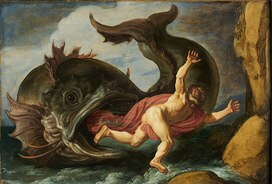
The short, fast-moving story opens with God instructing Jonah to go east from Israel to Assyria to “cry out” against wickedness in the city of Nineveh. Jonah flees in the opposite direction, by sea. A storm hits, the ship’s sailors attribute it to Jonah’s flight from God, and he volunteers to be thrown overboard. A fish swallows him and spews him out on land three days later.
This time Jonah obeys God and goes to Nineveh, where his shouted warnings work: the people repent, and the mind of God, who would have punished the city, is changed. The story ends with Jonah arguing with God about why Nineveh was spared.
Jesus of Nazareth mentions Jonah in Christian scriptures (Matthew and Luke), and Islamic scriptures also regard him as a prophet (Koran, suras 10, 21 and 37), also known as Yunus or Dhan-Nun.
Extra credit
Most versions of the Bible translate the Hebrew word for what swallowed Jonah as “great fish” or “large fish.” Some translations of Matthew quote Jesus as saying “whale,” and popular stories and songs often speak of “Jonah and the whale”… The biblical book 2 Kings briefly mentions Jonah as a prophet, son of Amittai, “from Gath-hepher,” who delivers an oracle to King Jeroboam (ruler of Israel, 786 to 746 B.C.).